$8.97
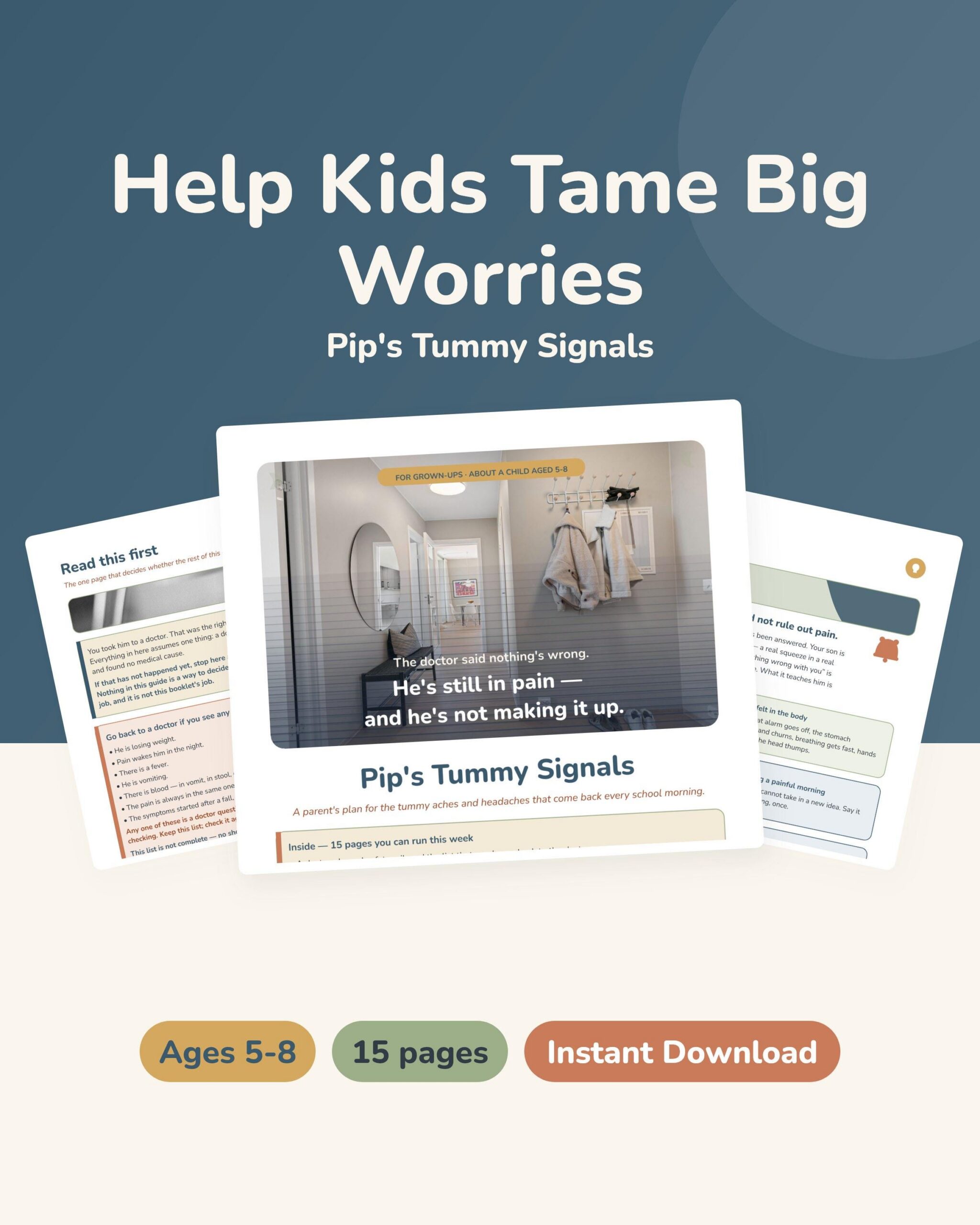
Child stomach ache before school — a 15-page printable CBT parent guide for ages 5-8, for the recurring tummy aches and headaches a doctor has already examined and found no medical cause for. The doctor said nothing’s wrong. He’s still in pain — and he’s not making it up. Instant digital download; print at home in A4 or US Letter.
The examination ruled out disease. It did not rule out pain. Those are two different questions, and only the first one has been answered. What your son reports is a real squeeze in a real stomach, a real ache in a real head — and nobody has yet told you what to actually say at 7:40 in the hallway with the bus coming. This guide starts where you are standing: cleared by a doctor, still holding a child in pain, and quietly wondering whether you are missing something.
What it then explains is the loop the pain sits inside — how a body that hurts, gets watched, and gets sent back to bed learns that the morning can be ended. Not “it’s all in his head.” A real signal, a real alarm, and a set of grown-up moves that shorten the morning instead of feeding it. Written for the parent, not as a colouring page for the child.
What’s inside — 15 pages. That means 11 pages you actually run the week from, plus 4 pages around them — the cover, the one page written for your child, the printing guide and the licence.
- A doctor-cleared safety rail with the go-back-to-a-doctor list — weight loss, night waking, fever, vomiting, blood, pain always in one spot, symptoms after an injury — printed alongside the plain statement that no short list is complete, and that anything new, different or getting worse is a doctor question too. Written as partnership with your vigilance, not as small print.
- Why the pain is real — four steps, including the words to say out loud on a calm evening, plus a blank for the one signal your child reports first.
- The cycle map — “How one day off becomes three months” — including the version that runs even when you *do* send him.
- A one-week log with a filled-in worked row: the deliberate replacement for the daily belly-press and the fourth “does it still hurt now?”. Then four questions that read your own rows back to you.
- The 7:40 script — five moves, word for word, ninety seconds, including the one line your child says with you.
- The 10:30 school-call script — what you say to the office and what you say to your child when they hand him the phone. Rest, then back to class, not collection.
- A graded return-to-school plan — five rungs, move up after two good days, repeat a rung without calling it failure.
- The boring sick-day rule with its three-lane test — genuinely ill, a planned rest day (allowed, and a good idea), or a day bought with a symptom. A rule, not a judgment.
- Four things to stop and what to do instead, plus the household-consistency box: partner, grandparent, older sibling, teacher.
- A detachable one-page teacher handout you fill in, sign and hand over.
- One page for your child — read aloud together, no writing, no scales, one short line he says himself.
- A five-problem troubleshooting page — including the three-week mark — plus a printing guide and the licence.
Why this one is different. Parent-facing worry guides exist, and some of them are good. What none of them answers is the question you are actually holding: a doctor examined him and found nothing, so what am I still watching for, and what do I do at 7:40 tomorrow? This is the plan for the morning *after* the clearance. It carries the doctor-cleared rail with its go-back list — and its refusal to pretend that list is complete — alongside the one-week log, the two clock-specific scripts, the sick-day lanes, the graded return and the teacher handout. Those tools only make sense once a doctor has said your child is fine, which is why a general worry guide has no reason to carry them. Created by a mental health professional with a PhD. Built on published CBT research.
How to use it 1. Twenty minutes on one calm evening — read from the doctor-cleared safety rail through to the sick-day rule, and decide that rule on a Sunday, not at 7:40 on a Tuesday. 2. Two minutes a day for seven days — the 7:40 script at the door, one log row after he is in bed. 3. On day eight, read the log with the four questions. Take it to the school and to your GP.
Questions parents ask – What is this? A 15-page printable parent guide for the recurring stomach aches and headaches a doctor has already cleared. It explains the body-worry cycle and gives you the exact grown-up moves — two scripts, a one-week log, a sick-day rule, a graded return — that shorten the morning instead of feeding it. – What age is it for? Written for the parent of a 5-8 year old. The reader is the grown-up; a single page inside is written for the child, read aloud together. – What’s included? 15 pages: a doctor-cleared safety rail with a go-back list, a cycle map, a one-week log with a worked row, the 7:40 door script and the 10:30 school-call script, a five-rung return-to-school plan, a sick-day rule, a teacher handout, a page for your child, and a troubleshooting page — plus a printing guide and licence. – How do I use it? Twenty minutes on a calm evening to read it through; then two minutes a day for a week — one script at the door, one log row at night. On day eight you read the log back and take it to school and your GP. – Do I get a physical product? No — instant digital download, nothing is shipped. You print it yourself at home. – Can I print it more than once? Yes — print unlimited copies for your own family or single classroom.
Specs: instant digital download, nothing ships. PDF in A4 and US Letter. 15 pages. Print unlimited copies for your own family or single classroom.
Important note: this guide is written for families whose child has already been examined by a doctor for these symptoms with no medical cause found. It is an educational parenting tool and it is not a substitute for therapy or professional care. If you are worried about your child’s health, a doctor answers first — every time.
Product type: printable parent guide (PDF ebook) Age: 5-8 Pages: 15